
Jerry had a simple rule: “Don’t go into the 18-yard box unless the ball goes in there.”
I didn’t think it was a big deal at the time. But it has become a staple of my coaching, forming the basis of our defensive principles and a daily reminder to keep it simple!
I had the privilege to coach under the legendary Jerry Smith at Santa Clara University from 1998-2001. I had graduated from SCU a decade earlier and it was great to come back and be part of a fantastic coaching team. Jerry, Eric Yamamoto and Brandi Chastain were great colleagues. We got to work with some great players as well.
Wow, I learned a lot from Jerry and the team. We had some great teams. We scored goals in bunches. We were an early proponent of the 4-3-3 system, now commonplace. However, many of the lasting principles were defensive ones. And the simplest one comes first…DRAW A LINE!
Why hold the defense at the 18-yard box?
While we are defending, there comes a point where we have to stop backing up. For obvious reasons, it’s not a good idea to retreat into the goal. At some point, we have to stand our ground and draw a line…tackle, block, dispossess and disrupt the attacking team.
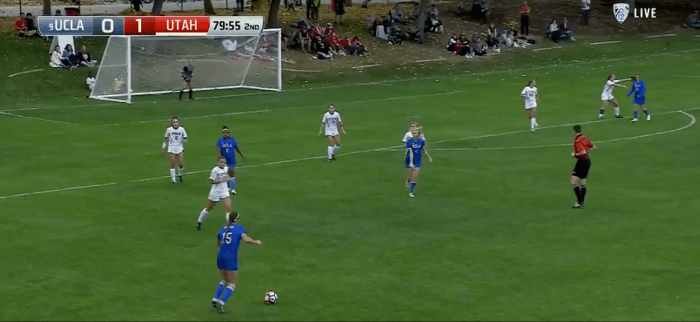
Why draw a line?
- Be close enough to the ball to tackle the dribbler, block a shot and crowd the attack.
- Create a line to try to get the attackers offside.
- Make space for our goalkeeper to see clearly and make a play.
Why draw a line at the 18-yard box?
- It’s a natural line – easy for players of all ages to see and use as a guide.
- It allows us to crowd the attackers as they get into shooting range. Most of the time our goalkeepers can save a shot from 20-25 yards. So, we make sure shots are contested from this range or taken from further out.
- This seems to be the right amount of space between our defense and the goalkeeper. So, if a ball is played behind on a pass or dribble, our goalkeeper can get to it.
A Pair of Situations
There are two basic situations that come up regularly. The first is when the opponent is coming into your defensive third of the field. Your defense is backing up as the attack heads to goal. The principle, again, is to stay out of the 18-yard box unless the ball goes in there. Often times, it looks like this:
The second situation is when the ball does go into the 18-yard box. Clearly, at this point, we have to go in there to try to stop the attack. Once we are in there, we defend fiercely as it is a dangerous moment. If the ball goes back out (by a clearance, block or a backward pass from the attackers) then we must get back out of the 18-yard box with urgency. We use Jerry’s words, “FIRE OUT“.
(NOTE: In some cases, you don’t have enough time to get all the way out. You can use the 6-yard box and penalty spot at 12 yards as guides in those instances. There are exceptions and gray areas, but I want to focus on the best way to start the process here).
Often times, it looks like this:
Draw a line in training. EVERY DAY.
There it is. The concept is simple. It’s important to train on it as much as possible. No excuses because it’s easy to do. Nearly, every time we play to goals (big goals or small goals), we draw a line representing the 18-yard box. It doesn’t have to be actually 18 yards from the goal. Put it at an appropriate place for that exercise No matter what we are training on, holding that line is emphasized that day.
Be prepared to call offside. If you are asking players to hold a line, you must reward them with one of the biggest benefits! This is another part of defending that players need to practice and no better place then right in front of the goal to learn.
I watch many youth games each year. And I see defending as a part of the game that most players could do better. Many of our freshmen players come to Utah needing a lot of work in this area.
There are many parts of soccer to work on and, at times, team defending can get pushed to the back of the line when we don’t have enough time. However, this is an easy way to get better and can be incorporated into MOST sessions. Give it a shot and let me know how it goes. If it works, you can join me in thanking Jerry.
 Coach Manning