
“Sometimes I wonder what I’m a gonna do, but there ain’t no cure for the summertime blues.” – Eddie Cochran – “Summertime Blues”
On April 22nd, our team gathered together for the last time and talked about being safe, staying connected and working hard. And that’s when the sadness and worry kicked in!
May, June and July are such a bummer. I hate not being around our Utah Women’s Soccer team for that long. And all I do is worry!
We had a fantastic Spring semester, one of the best I can remember. The players worked hard to get better. We played some very good teams to test ourselves. We got a few players back on the field after serious injury. We learned a lot about our team. We were starting to find our stride as a group. And, just like that, it was over. We were done for 3 months.
We gave the players some ideas about what kind of training to do. And warned them that, in order to reach our lofty goals, they would have to come back on August 6th fit and sharp. Then it was good luck on finals and good bye!

Performance Coach, Cody Lockling, with some hints for the summer on our last day of Spring training.
We Need More Time
Why do I get so worried? For the next 97 days our players will be on their own. Our team’s success will in large part depend on its ability to function without structure…and without the coaches.
When we get back together on August 6th, we will have only 16 days to prepare for our first game. This is NOT ENOUGH TIME. It is not enough time to get a team ready. More importantly, it is not enough time for players to prepare safely and reduce their risk of injury.
Women’s soccer has a high injury rate, one of the highest of all college sports. Among women’s sports, soccer has the highest for injury rate for ankles, 2nd highest injury rate for ACL, highest for injury rate during games, and 2nd highest injury rate during practices (behind gymnastics).
The best solution to these problems is TIME. Players need enough training time for a gradual increase in their workload. This is the most important factor in preparing for a healthy, successful season. The bottom line is the 16 days allotted for preseason training prior to our first game is not enough time.
What Happens in the Summer?

Tom Iriye works with our players to keep them healthy all year long, including in the summer.
The NCAA rules regarding summer workouts are pretty simple. Players may not have any training or help from coaches. They may workout without a ball on a voluntary basis with a performance or strength coach. And they may be treated by an athletic trainer. We are fortunate at the University of Utah to have a great support system. Some of the resources available to our players are incredible. They include:
- An athletic trainer, Tom Iriye, that is around during the summer and makes time for our them.
- A performance coach, Cody Lockling, that is around during the summer and creates and executes plans for them whether they are around or away from campus
- Summer school scholarship money and tutoring to continue their studies
- Internship, volunteer hours and summer jobs in their field of study
Many of our players love to be here in the summer and take advantage of these resources. They can get a lot accomplished on and off the field.
However, there are some important things we cannot do in the summer to help our players prepare. We cannot help them with soccer skills and training. We cannot go over video or other forms of learning. We cannot force them to run, lift, train or get treatment. Heck, we can’t even know who is working out and what they are doing. Everything must be on a voluntary basis.
So, even though many of our players are here and want the help…even though they want to get better…even they want to have a healthy season…we can’t help them. Nothing until August 6th…and by then it is too little and, sometimes, too late.
Welcome to College. Now Find a Place to Live.
Our incoming freshmen also love to take advantage of our Summer resources. They can come to campus and start some classes. They can get to know their teammates and the support staff. They can take advantage of these resources. And they can try to get ready for their first college soccer season. They need this extra preparation time even more than the returning players as they will be putting their bodies and minds through a new kind of grinding season.
One huge question we get from incoming players and families is, “where do I live in the Summer”? Most of them live in the dorms during the academic year. And they could live in the dorms during the Summer for the 1-2 months they are in town. However, the dorms are expensive. They can get a place off campus for much less money.
Soccer is an “equivalency” sport, meaning we can give partial scholarships. With a roster of 25 or more players and 14 scholarships, the money gets spread out. Most of our players get little room and board money. So saving money is important to them.
NCAA rules prevent me from helping players find a place to live (with the exception of the on-campus housing). So I have this absurd conversation every year with the families of our new players:
ME: “Hey, come in the Summer and take advantage of Summer school, workouts and getting ready for the season with your new teammates.”
FAMILY: “That sounds fantastic! So, I’ll be able to work with you on my game?”
ME: “Uh, no. We can’t do that, but you can run and lift!”
FAMILY: “Well, um, okay. Where can we live?”
ME: “Well I can set you up on-campus, but it’s more expensive. Or you can find a place off-campus.”
FAMILY: “Okay. Dorms sound expensive. We prefer off-campus. But you’ll help us find a place in this new city, right?”
ME: “Well, I’m not allowed to do that. You’ll have to find a place and then figure out how she will get to campus each day.”
FAMILY: “SOLD!”
It’s a crazy way to welcome someone to your campus and program. And it’s maddening for family sending their child away from home for the first time. It’s not comforting. It’s not right and it needs to change.
A Ray Of Hope From The Sun Belt Conference?
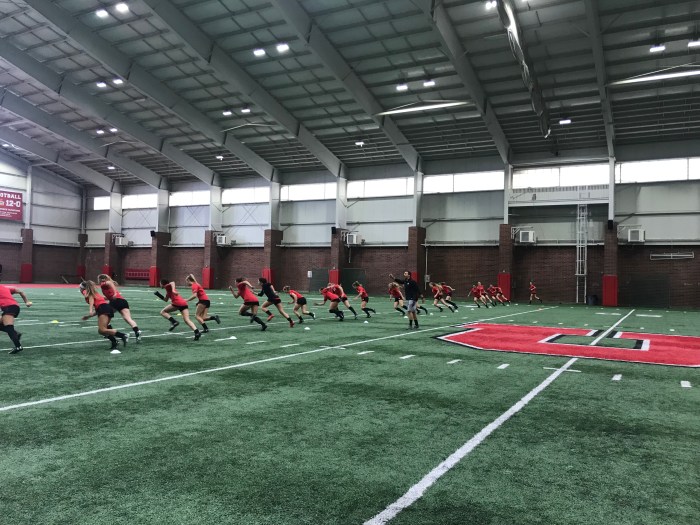
No Ball Allowed! Current rules restrict supervised summer workouts to running and strength work!
“Well, I called my Congressman and he said, quote, ‘I’d like to help you son, but you’re too young to vote.'” – “Summertime Blues”
The Sun Belt Conference put forth an NCAA Proposal (2018-57) this year which offered some common sense and a ray of hope. It allowed 4 weeks of training prior to the beginning of preseason. It would allow 8 hours of training each week. And 4 hours each week could be on the field training with a soccer ball! And players and coaches could work together! WOW! The proposal applied to soccer and volleyball programs. Two sports that start early and need preparation TIME.
Some simple math:
4 weeks of 8 hours + 16 days of preseason training camp = 6 weeks of prep
Now that is a proper amount of time to allow a gradual increased workload. That is enough time to produce:
- Better soccer
- Healthier players
- Safer environment
Unfortunately, this common-sense solution was tabled. There was some confusion about what was in the proposal. It will be looked at again next year.
We NCAA Women’s Soccer folks have some challenges with new proposals. We are a younger sport compared with basketball and volleyball. We don’t have as many people at the administrative level (at our schools, at the conference level and at NCAA) that have played or understand our sport. And we have a hard time getting things passed to move our sport forward.
In this case, there is some reluctance to add weeks to our summer calendar for 2 major reasons:
- Summer training may add some expenses to athletic department budgets
- Asking athletes to give up some of their summer is a concern for administrators
However, these extra weeks…this extra TIME is critical to the health, safety and success of our players. And the time has come to get rid of our SUMMERTIME BLUES. Here’s hoping next summer brings positive change. Until then, I’ll worry and sing with Eddie Cochran.
 Coach Manning